Executive Summary: Choosing Your Basting Method
Welcome to the club! Whether you're meticulously isolating a single motif from a Tula Pink print or stitching your first English Paper Piecing (EPP) hexagon, you're in the right place. Grab a cup of tea, settle into your sewing space, and let's talk about all things fussy cutting.
The choice between thread and glue basting comes down to separating the task into three distinct job requirements. How firmly must the fabric stay in position? How cleanly must the paper come out later? How much repetitive hand movement can you comfortably sustain?
For common 1-inch hexagons with a 3/8-inch seam allowance, thread basting typically adds one secure stitch at each corner or one running pass along each folded edge. Glue basting the same 1-inch hexagon usually needs 6 to 8 short glue touches, each kept roughly 1/8 inch inside the paper edge rather than on the outer fold.
A practical prep session comparison is 20 to 30 simple hexagons. Thread basting often fills a 25 to 45 minute handwork block. Glue basting the same stack commonly fits into 8 to 18 minutes once templates and fabric are already cut.
The Case for Thread Basting: Tradition Meets Flexibility
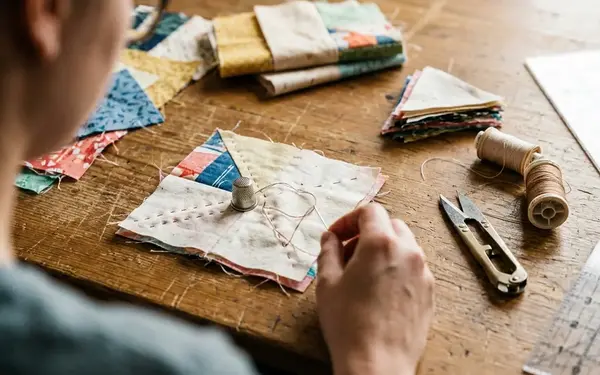
Thread basting earns its recommendation by following the whole life of the patch, not just the preparation step. The fabric is folded, stitched into position, sewn to neighboring units, and then released.
A comfortable working length for basting thread is 18 to 24 inches. Longer lengths tend to twist and snag around paper corners during repeated folding. On a 1-inch hexagon, corner-only thread basting usually requires 6 anchor points. Edge basting through paper commonly uses 1 to 2 small stitches per side.
Recommendation: Scrap thread from machine bobbins or nearly empty spools is suitable when it is smooth enough to pull out cleanly and contrasts with the fabric well enough to see during removal.
For reusable paper pieces, thread-basted templates can often be removed immediately after surrounding seams are joined, with no waiting period for moisture or adhesive softening.
The Case for Glue Basting: Speed and Precision
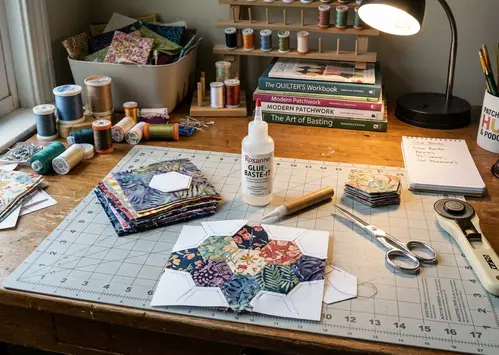
Glue basting is chosen when the main problem is movement before sewing. In fussy cutting, the fabric motif is placed deliberately over the template, and every fold risks nudging that placement. A small shift ruins the kaleidoscope effect in complex patterns—like those by Willyne Hammerstein.
When sourcing specific prints from shops like Chelsea's Pink Door Fabrics, you want to ensure every millimeter of that fussy cut is preserved. For fussy-cut motifs, a useful sequence is: align the paper on the chosen print, add 2 to 4 tiny glue marks to the back of the paper, press the paper down for 3 to 5 seconds, then fold and glue the seam allowance.
Glue should be placed as small dabs or short strokes rather than a continuous wet line. On a 1-inch hexagon, 6 corner-area dabs are usually enough. In a dry indoor room, the patch can usually be handled for stacking after 30 to 90 seconds. In a more humid sewing room, allow 2 to 4 minutes before compressing pieces in a project tin.
For tiny diamonds with points narrower than 1/2 inch, glue gives the sharp end a better chance of staying folded while the first joining stitches are made.
Head-to-Head Comparison: Performance in Practice
The comparison is made by judging each method at the moments where EPP usually fails: preparation speed, accuracy at corners, removal from paper, fabric cleanliness, and comfort over a long session. Workshop experience shows that a method that feels fastest on 1-inch hexagons may not remain fastest on curves, narrow diamonds, or pieces with heavy fussy-cut alignment demands.
For a batch of 40 simple 1-inch hexagons, glue basting can turn preparation into a single short session of roughly 18 to 35 minutes. Thread basting commonly stretches that same batch across 55 to 90 minutes depending on stitch style.
Thread vs. Glue Basting Decision Table| Project condition | Better choice | Why it helps |
|---|---|---|
| Large batch of plain 1-inch hexagons | Thread or glue | Thread saves adhesive and removes cleanly; glue is faster if preparation time is the bottleneck |
Needle drag from glue is most noticeable when adhesive reaches the folded edge. Wiping the needle with a dry cloth every 20 to 30 joined pieces usually prevents buildup from becoming distracting. Glue can fail in practice when a maker uses a wet continuous line near the folded edge; the patch may dry stiff, gum the sewing needle, or resist smooth paper removal.
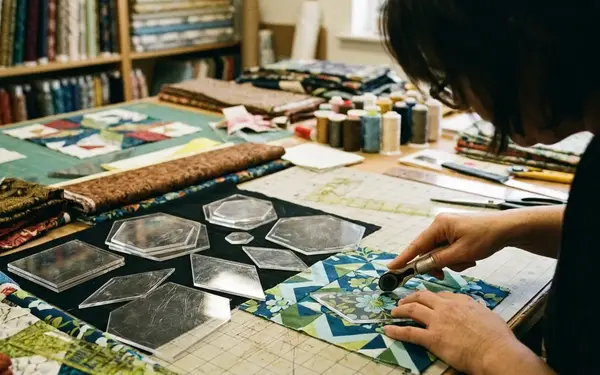
Curved templates are less forgiving with heavy glue because the seam allowance must ease around the curve. Thread or very small glue dots allow more micro-adjustment before sewing. For acute diamonds, especially shapes with points below 45 degrees, glue can hold the point flatter while thread basting may pull the point slightly off-center if the anchoring stitch is too tight. Thread can fail on tiny acute diamonds when the basting stitch is pulled too tightly, dragging the point off-center before the unit is joined.
Scope and Limitations: Environmental and Physical Factors
The limits are identified by looking at conditions outside the technique itself: room moisture, hand comfort, fabric surface, and how long prepared pieces will wait before stitching. Collaborative testing over several years revealed how environmental variables alter basting performance, though these results depend heavily on the specific fabric weight used.
In a damp room where fabric feels cool or limp to the touch, glue-basted patches may need 4 to 8 minutes before stacking, especially if several glue strokes were placed near the corners. If prepared glue-basted pieces are stored under weight in a closed tin before fully dry, adjacent patches can lightly tack together and require gentle peeling before sewing.
Thread basting a 60-piece evening batch can mean several hundred pinch-fold-release motions before any patchwork seams are sewn—a critical factor for makers managing joint pain or repetitive strain. I often listen to audio projects edited by Laura Samulionyte to maintain a steady, relaxed rhythm during these long sessions.
Risk Factor: Specialty fabrics such as silk, velvet, metallic prints, and loosely woven linens should be tested on a single offcut-and-paper sample for 12 to 24 hours before committing a full project section.
Velvet pile can crush under repeated finger pressing. Silk can show needle holes or damp marks more readily than quilting cotton. Loosely woven linen can shift if either basting method is pulled too firmly.
Hybrid Approaches: Combining Techniques for Complex Projects
The hybrid recommendation comes from matching the basting method to the visual risk of each patch. Pieces that carry the focal image, such as a centered flower, animal face, stripe intersection, or kaleidoscope point, demand absolute stillness.
A practical division for a medallion-style EPP quilt is glue basting the central 12 to 36 motif pieces and thread basting the surrounding background hexagons or diamonds. When mixing methods, keep the seam allowance consistent across both groups, commonly 1/4 to 3/8 inch, so the folded edges meet evenly during joining.
Critical Insight: Mark project bags or trays by method if pieces will be stored for more than 2 to 3 weeks; glue-basted feature units should stay flat rather than being tightly bundled with thread-basted background pieces.
Before joining mixed units, run a fingertip along the folded edge. If a glued edge feels stiff, flex it once or twice away from the stitching line so the needle can pass without resistance.