The 12-Month Journey to Your Sewing Room
Whether you are meticulously isolating a single motif or stitching your first English Paper Piecing (EPP) hexagon, understanding how fabric is made transforms how you cut it. Grab a cup of tea, settle into your sewing space, and trace the journey of your favorite prints. A traditional quilting-cotton collection commonly takes 9 to 12 months to move from initial sketches to independent quilt-shop shelves. Artwork and color planning may occupy 6 to 12 weeks. Strike-off review can consume another 4 to 10 weeks when more than one correction round is needed. Production, finishing, freight, and distribution account for much of the remaining calendar.
Strategic Planning Payoffs
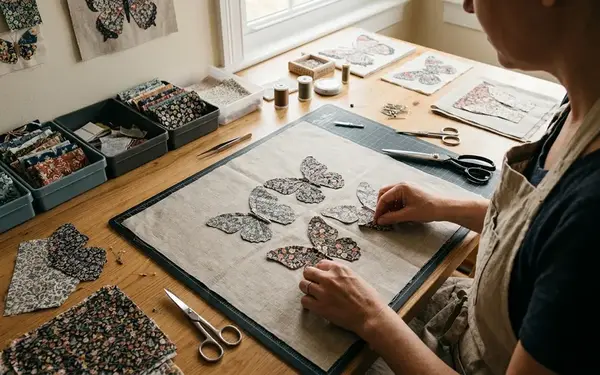
Knowing this timeline gives quilters an advantage when planning projects. For an EPP project requiring 24 identical motif placements, the useful planning number is 24 complete motifs plus the cutting margin, not merely the finished number of hexagons. Counting finished shapes alone leaves you short on fabric.
Criteria for Selection: What Makes a Print 'Fussy-Cuttable'?
This guide focuses on traditional woven quilting cotton, generally sold at a nominal 44-to-45-inch width, for the independent craft market rather than wide apparel goods or big-box utility textiles. Evaluate every production stage by what it changes at the cutting table. First, compare motif dimensions with the intended paper shape. Next, inspect the clear space surrounding each motif. Finally, check the registration.
- Dimension Check: For a 1-inch hexagon measured by side length, the cutting template needs a seam allowance beyond the paper edge. A 3/8-inch allowance is a practical inspection margin when deciding whether adjacent artwork will intrude.
- Spacing Analysis: Record motif spacing in both directions. A flower repeating every 6 inches across the width but every 12 inches along the length yields a different usable count from an evenly spaced 6-by-6-inch repeat.
1. The Initial Concept and Color Story
The designer normally establishes the collection hierarchy before polishing every coordinate. A large or narratively dense hero print carries the theme, medium-scale designs bridge it into blocks, and small-scale tonals provide resting space. Motif spacing is planned at the sketch phase, which directly dictates how much negative space a fussy cutter will have to work with. A hero motif measuring 2 1/4 inches across will not sit intact inside a 2-inch viewing window, even if the surrounding print appears spacious on the bolt.
For six matching EPP pieces, inspect at least six complete copies in the same color and orientation. Mirrored motifs are not interchangeable when directional details such as faces, stems, or lettering are present. A clear border of roughly 3/8 to 1/2 inch beyond the paper edge gives room for seam allowance and minor placement adjustment.
Kaleidoscopic Contrast Effects
Drawing on the geometric layouts popularized by Willyne Hammerstein: author of Millefiori Quilts, high-contrast color stories yield the most dynamic kaleidoscopic effects in EPP. Look for collections that push value differences to the extreme.
2. Strike-Offs and Color Corrections
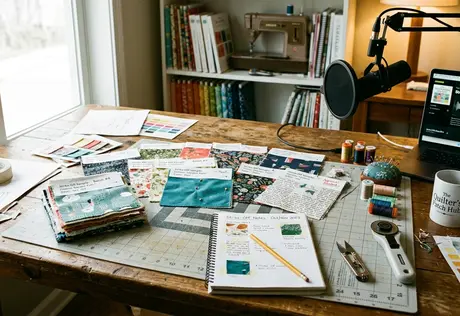
Strike-offs are short test printings made before bulk production. The designer or production team compares them with approved artwork, judging hue, line sharpness, penetration, and registration under controlled lighting. A correction cycle can take 2 to 5 weeks once file changes, mill scheduling, printing, shipment, and review are included. Two rounds therefore add materially to the release calendar.
Traditional screen printing requires a separate screen or printing station for each spot color, so designers may merge shades or let one layer overprint another. Digital textile printing does not require a screen for every color and can render effectively unrestricted tonal transitions within the printer's ink set and fabric gamut. Review pale backgrounds beside one another under the same daylight-balanced source. Two coordinates marketed as sharing one background color may sew together as cream and pale blush because they were printed from separate ink mixes or production setups. Cream-versus-pink shifts that disappear at arm's length can become obvious when two EPP patches share a seam.
3. Scaling for Yardage vs. Precuts
Scaling decisions are tested against two viewing frames: the full usable width of a bolt and the small window presented by common precuts. A broad repeat can create an impressive sweep across yardage. Quilting cotton is commonly labeled 44 to 45 inches wide, although the printable width between selvages may be closer to 42 to 44 inches.
A charm square is 5 by 5 inches. A 5-inch precut can contain only a clipped portion of a 5 1/2-inch flower, while the same design on continuous yardage may provide several intact flowers around the cut boundary. A motif placed across a precut boundary may be divided even when its diameter is smaller. Measure the repeat parallel to the selvage and across the width. If the same medallion returns every 12 inches along the length, six identical placements require access to multiple repeat rows rather than six arbitrary 12-inch areas.
4. Mill Production and Printing Methods
During bulk printing, the cloth travels through successive color applications. The colored circles or blocks commonly printed on the selvage identify the palette or screen colors. Dedicated crosses, targets, or overlapping shapes help the mill monitor alignment.
Registration Shift Risks
The selvage color dots can match perfectly while a fine black outline is visibly displaced from the colored motif, so the printed artwork—not the dots, must be inspected for registration. A shift of 1 to 2 millimeters is easy to see where a dark outline is meant to meet a pale face, eye, petal, or geometric edge, even though it may be unobtrusive in a scattered tonal. Check registration near the left edge, center, and right edge of the usable width. Alignment can vary across one piece rather than failing uniformly.
Drawing on an interview with Laura Samulionyte: audio editor, the finding confirms that precise alignment in any layered medium dictates the final quality. The finishing process gives quilting cotton its specific hand-feel and stability. Stable quilting cotton accepts a finger-pressed EPP fold more predictably than a loosely woven or fluid cloth, especially around points where several seam allowances converge.
5. Quilt Shop Curation and Bundling
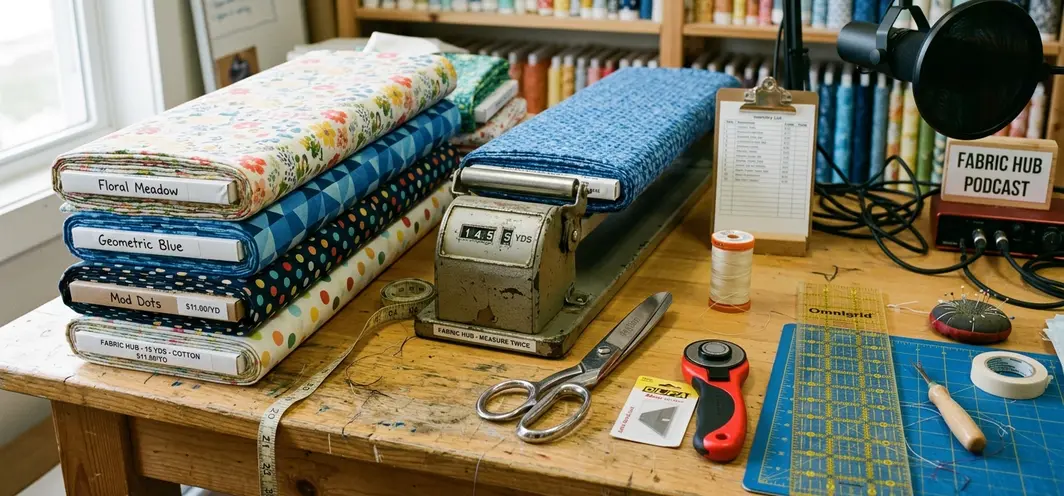
A quilt shop curates by balancing visual range, shelf space, expected demand, and the commitment represented by each full bolt. Staff may buy the hero prints, several coordinates, and useful tonals rather than the entire line. If a collection contains 40 prints, carrying every design can mean committing shelf space to 40 separate bolts. A curated order may consequently omit alternate backgrounds or duplicate colorways that matter to motif matching.
Retail buying decisions may be placed 3 to 6 months before fabric reaches the shelf, making the preview or preorder period the strongest window for requesting an omitted print. A fat quarter cut from standard quilting cotton is approximately 18 by 21 to 22 inches. Its shape offers more width than a conventional 9-inch quarter-yard cut but still captures only a limited number of large repeats.
The Cutting Table Verdict
The cutting-table verdict follows from repeat geometry. Precuts optimize variety, while fussy cutting requires control over position and duplication. Before cutting, mark every required motif through a clear template and count the complete placements. For a six-piece kaleidoscope, reserve all six before cutting the first one so a hidden flaw or partial repeat does not strand the block. A half-yard measures 18 inches along the selvage by the usable fabric width, commonly about 42 to 44 inches after excluding the selvages. One catch exists: a half-yard improves positioning freedom but cannot guarantee enough identical motifs when the repeat is longer than 18 inches or only one usable copy occurs across the fabric width. Verify the repeat before fixing the final quantity.
Stop asking a random 5-inch square or fat eighth to do the work of yardage. If you find a focal print you love for fussy cutting, commit to buying at least a half-yard to guarantee you have the repeat flexibility required for complex blocks.