Key Takeaways: Achieving the Mirror Effect
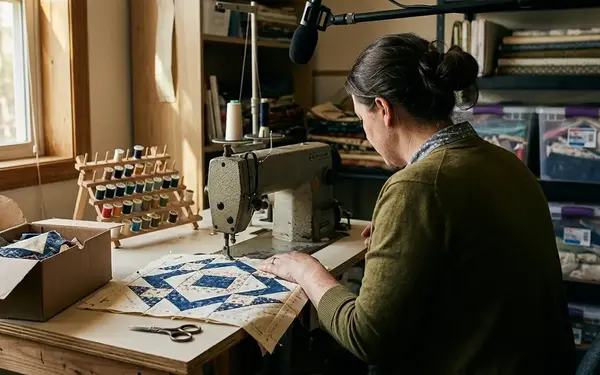
Welcome to the club! Whether you are meticulously isolating a single motif from a Tula Pink print or stitching your first English Paper Piecing (EPP) hexagon, you are in the right place. Grab a cup of tea, settle into your sewing space, and let us talk about all things fussy cutting.
I decide whether a fabric is worth mirroring before cutting by checking three things in order. The repeat must be measurable. The motif needs a clear center or edge feature. That same feature must appear consistently across the yardage. For a first mirrored EPP block, plan for roughly 45 to 75 minutes of layout and checking before any stitching begins.
Critical Insight: Useful registration features are small but visible. Look for a flower center, animal eye, leaf tip, dot cluster, stripe intersection, or printed outline corner.
A 1/4-inch seam allowance should be drawn or etched on your template so the visible motif is judged inside the finished shape, not at the raw edge. Expect to cut from separated repeat positions rather than adjacent fabric areas. Leave at least 1/2 inch between marked shapes when rotary cutting to avoid nicking the next placement.
Understanding the Mirror Effect in Fabric Geometry
I define the mirror effect by looking at the finished seam line, not the unsewn patch. If two identical motif fragments meet along a seam and visually reflect each other, the block has mirrored symmetry.
In EPP, the mirror effect is easiest to read in shapes with strong meeting points. These include 60-degree diamonds, equilateral triangles, hexagons, and jewel shapes. A motif fragment that sits 1/8 inch away from the seam on one patch should sit the same 1/8 inch away on its mirrored partner to avoid a wobbling center line.
Directional prints with stems, birds, faces, lettering-like marks, or sweeping vines reveal alignment errors faster than scattered blender prints. Before cutting, fold or mirror-preview a motif along the intended seam line for half a minute or so. If the new shape does not appear at the fold, the fabric may read as repeated rather than mirrored.
Workshop experience shows that understanding the geometry of tessellations and symmetry fundamentally changes how you view a bolt of cloth.
Essential Tools for Precision Alignment

I choose tools by asking whether they preserve the same visual reference from the first patch to the last. A standard ruler measures distance well, but it does not lock a flower center, dot, or printed outline corner—the very anchors of our craft.
A reliable method is to use clear acrylic templates with a center crosshair, a 1/4-inch seam allowance line, and at least one diagonal or vertical registration line. A hinged mirror opened to 60 degrees previews six-point repeats. Opened to 90 degrees, it previews four-point arrangements.
A 12-inch rotating cutting mat is sufficient for small EPP units. A 17-inch mat is more comfortable for larger hexagons or wide-repeat fabrics. Replace or sharpen the rotary blade when it begins skipping threads. Fussy-cut shapes often fail from dragging fabric by as little as 1/16 inch.
Recommendation: Fine-point removable markers or a mechanical pencil with a light touch are better than broad chalk marks when the registration point is smaller than 1/8 inch.
Step-by-Step: Creating Your First Mirrored Block
I begin by finding the repeat, then select one tiny printed feature as the registration point, because every later choice depends on returning to that same feature. After that, I place the template carefully.
Step 1: Measure the Repeat
Measure the repeat by locating the same motif twice along the lengthwise direction and again across the width. Record both distances before marking templates. Check at least three repeats before trusting the measurement, because printed cloth can shift slightly across the bolt.
Step 2: Establish the Registration Point
For a six-piece mirrored block, cut all six patches from the same repeat relationship. Do not mix one patch from a different scale area or a partial repeat at the selvage.
Step 3: Align and Cut
Trace the template with the fabric flat and unstretched, then cut with one steady rotary pass per edge where possible. When basting to papers, keep the chosen motif center visible on the paper side until the first two opposite edges are secured.
Limitations and Common Pitfalls to Watch For
I diagnose failed mirror blocks by checking the fabric before the sewing. First I compare the printed motif to the grain, then I check whether the registration point drifted inside the template.
Buy more fabric than ordinary patchwork requires. For small EPP units, an extra 1/4 to 1/2 yard is often the practical planning range when the repeat is medium to large. Chelsea, owner of Pink Door Fabrics, frequently advises quilters on sourcing adequate yardage for these specific continuous cuts.
If the print is skewed off grain by more than 1/8 inch across a 6-inch template area, prioritize the printed motif over the woven grain for visual matching, then handle the cut pieces gently. Large motifs spaced 8 to 12 inches apart can produce very few usable mirrored cuts from a fat quarter, especially when six identical placements are required.
Bias-heavy triangles and diamonds should be lifted, not dragged, from the cutting mat. Store them flat until basting. A mismatch of 1/16 inch at the center seam may disappear in a busy floral, but the same mismatch is obvious in stripes, eyes, stems, or geometric outlines.
Risk Factor: The mirror effect is unreliable on prints with intentionally irregular spacing, watercolor-style blurred edges, or motifs that change scale across the fabric. A floral print with beautiful roses can still make a muddy mandala if each rose is spaced differently or if the usable repeat lands partly inside the selvage area.
Peer feedback from audio editor Laura Samulionyte indicates that even non-quilters notice when a 1/16-inch alignment error spoils a mirrored block made from high-contrast geometric prints, though the same shift is acceptable in dense botanical fabric.
Case Study: Building a 6-Point Symmetrical Mandala
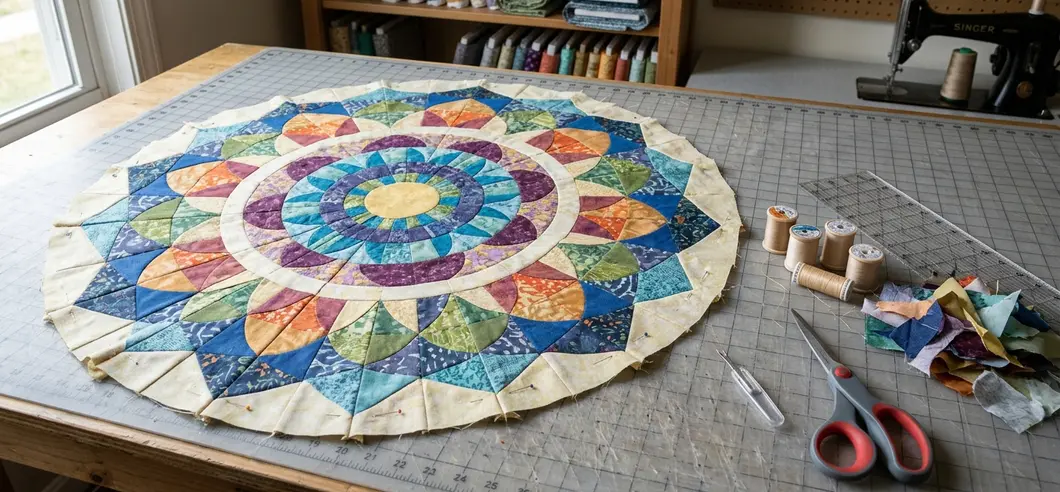
For a six-point mandala, I choose the central meeting point first, then work outward seam by seam. The decision is not based on whether one diamond looks pretty alone—it is based on whether six identical cuts can converge without creating a visual mess.
A 6-point mandala commonly uses six 60-degree diamonds or six equilateral triangles arranged around one center. This technique is heavily featured in the brilliant Millefiori Quilts by author Willyne Hammerstein. Use the same registration point for all six pieces, but rotate the template placement consistently so the motif travels around the center instead of flipping unpredictably.
Before stitching, arrange all six basted pieces on a flat surface and check the center from 12 to 18 inches away. This viewing distance reveals broken circles and offset petals better than close inspection.
Join the first three pieces as one half and the remaining three as a second half. Sew the two halves together so the center point can be controlled with fewer seams fighting at once. Finger-press or lightly press each joined pair for a few seconds before adding the next unit. Heavy steam can distort bias edges in small EPP shapes.
My ongoing multi-year exploration of fussy cutting confirms that gentle handling at this stage helps produce a flat, precise block, though this approach does ask for care with the pressing times noted.