The Verdict on a Working Motif Stash
Open a storage bin and the problem appears quickly: plenty of beautiful fabric, yet few usable sets of repeated motifs, quiet grounds, or framing prints. Money remains tied up in cloth chosen for its impact on the bolt rather than for what stays visible inside an English Paper Piecing template.
The practical verdict is firm: curating by motif type, print scale, and color role is the only reliable way to prevent stash bloat. These three criteria turn fabric into measurable EPP jobs. Colour alone cannot tell you whether a print contains six matching repeats, whether its focal subject fits a 1-inch hexagon, or whether it can frame a diamond without swallowing the centre.
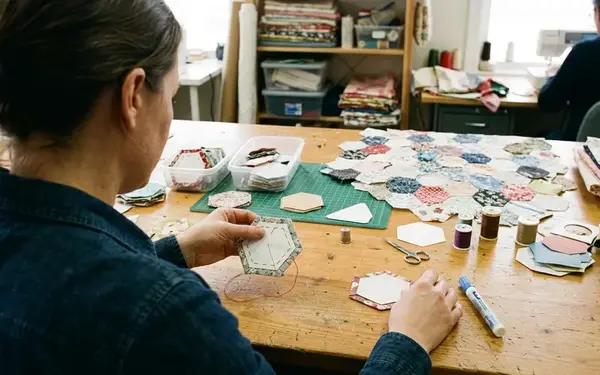
I use a blunt admission test. Place the actual template over the candidate fabric before assigning it shelf space. A 1-inch hexagon, 1.5-inch hexagon, and 2-inch 60-degree diamond will each expose different possibilities. The uncut print may look generous; the cutting window often tells a tighter story.
Bin-Test Standard
Give one storage bin a focused 20–30 minute review. Separate immediately usable fabrics from attractive prints that lack sufficient repeats, contrast, or compatible scale. Keep the first pass quick. Detailed project planning comes later.
A smaller collection built around repeatable functions can support more combinations than a large colour-sorted hoard. Quiet grounds move between projects. A useful geometric can rotate through several block structures. A novelty print with enough repeated figures can supply a complete set of centres rather than one promising cut and five compromises.
Sorting Florals, Geometrics, Novelties, and Architectural Prints
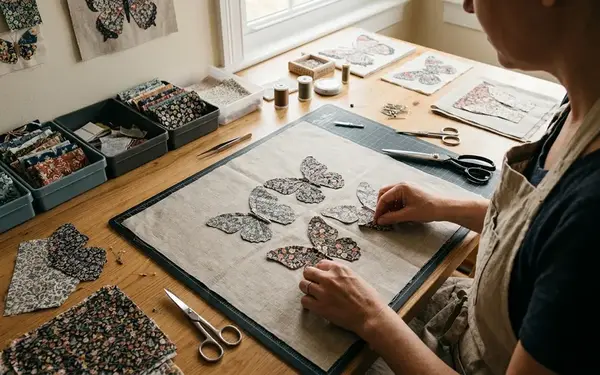
Sort according to what the cutter can isolate. This shifts attention from the overall fabric design to the unit that will survive cutting and piecing.
- Florals: Identify complete blossoms, petals, leaves, or bouquets that can repeat around a centre.
- Geometrics: Look for rotational symmetry, stable intersections, and lines that can meet cleanly across adjoining edges.
- Novelty prints: Count recognisable figures or objects with matching orientation. These usually work best as distinct centres.
- Architectural elements: Isolate windows, arches, tiles, gates, and borders that can create structure inside diamonds or hexagons.
Measure the Printed Subject
Use three practical scale bands: small motifs up to 1 inch, medium motifs over 1 inch through 3 inches, and large motifs over 3 inches. Measure the printed subject itself rather than the empty ground around it.
Next, place a transparent template over several repeats and include a 1/4-inch seam allowance beyond every paper edge. Count only complete motifs contained by that expanded cutting window. For a six-piece kaleidoscope, locate six matching repeats plus one spare before purchasing. Seven partial motifs or mixed orientations do not produce the same usable yield.
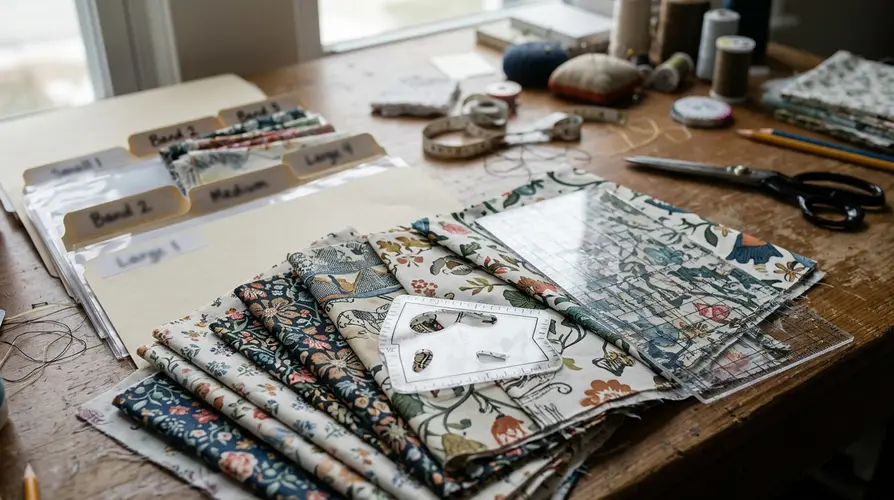
Large-scale prints deserve a smaller place in the stash. They create striking focal cuts, though their yield per yard falls sharply when only one portion of each repeat fits the template. Small geometrics and compact florals generally offer more cutting positions.
Repeat calculations also need a boundary. Tossed, non-directional prints with irregular spacing resist tidy estimates. Map the intended template directly across the cloth before deciding how many complete units exist. This method takes longer, but it prevents a visually busy yard from masquerading as a high-yield one.
Giving Every EPP Colour a Job
“Pretty blue” is too loose to guide a useful purchase. Assign colour according to the work it will perform inside the block.
- Quiet backgrounds lower visual competition and preserve the legibility of the fussy-cut subject.
- Middle-value bridges connect the centre to stronger outer pieces without creating a hard visual stop.
- Dark or saturated accents supply a clear value or temperature shift.
- Framing prints use dots, bands, stripes, or directional marks to create secondary patterns across seams.
A conventional hexagon flower gives a clean test. Place one fussy-cut centre beside six surrounding hexagons. A narrow dark frame can make the centre appear crisp and jewel-like. Replace it with a middle-value stripe and the same centre may merge into a larger ring. A framing print with poorly placed bands can turn the group into an unintended solid patch.
Read the Diamond Junction
For 60-degree diamonds, audition three pieces together before cutting the full set. Positioning a stripe near the outer edge can build a larger triangle. Moving that stripe toward the centre can create a six-pointed star when the units repeat.
View the arrangement in grayscale as well as colour. The check reveals whether the focal motif holds its place against the frame. Keep light or quiet grounds, middle-value bridges, and dark or saturated accents available as functional groups; they can cross hue families freely. Readers working from the intricate layouts in Willyne Hammerstein’s Millefiori Quilts will recognise how strongly these value relationships control the final geometry.
Drawing the Line Between Yardage and Small Cuts
Start with the required cutting windows. Count the identical motifs, add one or two spares for placement errors, and map the complete set onto the measured repeat. Buy the smallest cut that contains that map.
A quilting-cotton fat quarter is commonly about 18 by 21 inches. Fat eighths commonly measure about 9 by 21 inches or 10.5 by 18 inches. Those formats suit one to four distinct novelty centres, isolated bouquets, or compact sets that do not require long repeat continuity. Scrap packs can work well when every chosen fragment contains a visible, usable subject.
When Continuity Requires Yardage
Reserve continuous yardage for three jobs:
- Backgrounds that run through a substantial part of the quilt.
- Directional stripes that must match across many units.
- Layouts requiring uninterrupted repeats beyond an 18-inch cut.
Suppose a measured lengthwise repeat is 12.25 inches and the layout needs three complete repeat bands. The mapped requirement reaches 36.75 inches. Purchasing 1 1/8 yards provides 40.5 inches, leaving room for straightening the edge and placing the cutting windows. Here, yardage protects the pattern plan rather than merely enlarging the stash.
Repeat Before Yardage
The yardage boundary comes from repeat-band continuity and the number of identical cutting windows. Isolated novelty centres belong in fat-quarter, fat-eighth, or scrap territory until the map demonstrates otherwise.
This discipline keeps the fabric budget attached to usable material. It also makes shopping calmer. A print either fills a documented gap or waits on the shelf. Chelsea, owner of Pink Door Fabrics, represents the kind of specialist fabric-shop context where motif-rich bolts can be especially tempting; carrying a template and written cutting requirement keeps the decision grounded in the planned block.
Run a Three-Fabric Stash Audit Today
Pull three fabrics that have remained unused. Leave the current favourites in place. The dormant cuts provide better evidence because each one already contains an unresolved purchasing decision.
Set aside roughly half an hour with one ruler, one transparent EPP template, and three temporary labels: motif, scale, and colour role.
- Name the motif family. Record floral, geometric, novelty, or architectural.
- Measure the dominant subject. Assign it to the small, medium, or large scale band.
- Choose one colour role. Mark it as a quiet ground, middle-value bridge, accent, or framing print.
- Test the cutting window. Inspect at least one full width-of-fabric section or the entire available remnant, including the 1/4-inch seam allowance.
- Count complete repeats. Record only motifs that fit and maintain the required orientation.
- Write the missing partner. Use a functional description such as “low-volume warm background for 1-inch hexagons” or “six matching medium-scale motifs for diamond centres.”
The motif–scale–colour-role breakdown turns three dormant cuts into defined EPP tasks instead of another colour-sorted pile. Finish with no more than three purchase targets. Pull those three unused fabrics now, place your regular template on the first one, and write its motif, scale, and colour role before opening another storage bin.